

Taureau
Administrator
The controversy over obtaining medical testosterone in Canada
A 2012 study1 found that one in ninety men in Ontario, Canada were being treated with a testosterone product. About six per cent of these men had a conclusive diagnosis of hypogonadism – a condition where the body doesn’t produce enough testosterone.
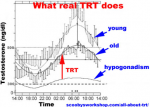
The above diagram shows how the Testosterone levels of young people, old people and those with hypogonadism fluctuate over the course of twenty-four hours. While average total testosterone (ng/dl) in men under twenty-five is about 6922, the diagram shows the testosterone level of those with hypogonadism being 300.
Physically, hypogonadism can lead to erectile dysfunction, infertility, osteoporosis (loss of bone mass) and decreased muscle mass among other effects. From a mental and emotional perspective, it can cause fatigue, decreased sex drive, irritability and hot flashes.
Because it has very similar symptoms to depression, hypogonadism often goes untreated due to misdiagnosis. This is especially common in young men, who doctors often assume have very high testosterone levels without actually checking.
Over the past two decades, the use of medical testosterone has increased significantly. Nearly three percent of American men aged forty and older are thought to have received medical testosterone prescriptions in 2011 – three times the percentage in 20013. IMS health who provide data for doctors reported that the market for testosterone supplements has grown into a $2 billion a year global industry and this does not take into account the large black market for testosterone replacement therapy (TRT) products. While not as common in Canada as it is in America, in the past five years Canadian sales of TRT products have risen by forty seven per cent.
Due to the assumption that young men have high testosterone levels, it appears that older sufferers of hypogonadism find it easier to obtain treatment than younger ones. Those under the age of thirty who go to clinics to seek TRT are often viewed very sceptically and labelled with depression instead of hypogonadism. Moreover, the high use of testosterone amongst athletes, bodybuilders and powerlifters to improve performance has furthered the scepticism
Individuals often become hypogonadal due to a disease state interfering with the pituitary gland, which releases hormones that stimulate the testes to produce testosterone. Lifestyle factors such as malnutrition, stress, extreme obesity and toxins (alcohol) can also contribute to hypogonadism.
TRT comes with a host of benefits and we have a full comprehensive list here: https://www.canadianbrawn.com/threa...osterone-replacement-therapy-in-over-40s.691/. To summarise it can improve mood, boost sex drive, aid in fat loss and muscle gain and improve performance as well as energy levels.
Despite the benefits of TRT, it also can come with negatives. For example there is a risk of shutting down your natural testosterone production and you may become dependent on testosterone to stay functioning. However, if you have hypogonadism then these risks may be worthwhile due to the benefits of TRT.
The prescription of TRT gives rise to a debate regarding whether we want hypogonadal men to be surviving with normal levels of testosterone or thriving with high levels of testosterone. Dr Larry Komer, a Canadian gynaecologist turned hormone doctor, has criticised the standardized ranges of testosterone that most blood clinics have listed as the healthy range for men. Because these ranges include the entire population from young men to the elderly, there is a huge variety in the range.
Generally speaking, male testosterone levels vary between 270 and 1070 ng/dL4. Because of the huge variety, a young man might get a blood test and be found to have a total testosterone level of 290ng/dL and still be considered as normal. In reality, while 290ng/dL may be a normal level for an old man it is arguably not enough for a developing eighteen year old. To quote Komer, the problem raised here is "the assumption is that men should be functioning rather than thriving."5
Individuals such as Komer have argued that "These ranges are so wide that it's ridiculous. No one should have to be 'OK' or 'average.' You don't go to a mechanic with two cylinders firing and ask him to bump you up to four. You want all eight cylinders firing, and there is a complacency in this sense when it comes to men and testosterone."
Research6 shows that for men who have symptoms of hypogonadism, trt can reduce depression and lead to an overall improvement in mood and well-being. Because of this, some doctors such as Komer have advocated for use of testosterone over antidepressants. Despite the benefits of TRT, doctors have to be very careful when prescribing it as once hypogonadal patients are on TRT they are unlikely to ever come off. In this sense TRT is not dissimilar to antidepressants with both treatment methods being long term solutions.
The disparity between Americans and Canadians on TRT is vast. A 2013 study7 found that eleven million men in America received treatment for testosterone related problems. On the other hand, in 2013 Canadian retail drug stores filed 550,000 prescriptions for testosterone replacement products8. Even with America’s larger population taken into account, Canada still has a significantly lower prescription rate of TRT.
The reason for a lower prescription rate in Canada lies in the lack of conclusive evidence that TRT is entirely safe. While TRT comes with lots of benefits, it also causes infertility in men and has potential for side effects such as hair loss.
Individuals such as Komer hope that testosterone will have a similar success story to estrogen. While estrogen was originally just prescribed for menopause, now it is prescribed for cancer, fertility issues and birth control. Maybe in twenty years time testosterone will be the same and widely available?
https://www.ctvnews.ca/health/numbe...stosterone-rises-dramatically-study-1.1916788
http://scoobysworkshop.com/all-about-trt/
http://elitemensguide.com/testosterone-levels-by-age/
https://www.scientificamerican.com/article/increasing-testosterone-use-raises-safety-concerns/
https://www.medicinenet.com/high_and_low_testosterone_levels_in_men/views.htm
5https://www.vice.com/en_ca/article/exq5nn/the-controversy-over-obtaining-medicinal-testosterone-in-canada
6https://www.ncbi.nlm.nih.gov/pmc/articles/PMC5209560/
7https://well.blogs.nytimes.com/2013/06/03/mens-use-of-hormone-on-the-rise/?_r=0
8https://o.canada.com/news/testosterone-use-growing-amid-new-safety-concerns


