

Previously from the other dutch forum I linked (no link anymore) I only read the first and last reply with a translator. I looked again at the middle of it and there's a counterargument made with another study on pubertal boys. However, the oldest boy in this study responded closer to the way men responded in other studies. Consider how differently females responded in previous studies, it isnt surprising that children don't respond well either. So, this is still the only negative study suggesting that only in pre - mid pubertal boys opioid antagonists don't raise LH. https://dacemirror.sci-hub.st/journal-article/22403cee2b654cd47185d1637b017f3e/kletter1991.pdf
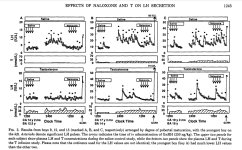
"To determine whether naloxone can reverse the suppressive effects of T on mean LH concentrations and LH pulse frequency, we studied eight boys (Table 1, boys9-16) according to the protocol depicted in Fig. 1. Results from boys 9, 12, and 15 are shown in Fig. 3. Patient 9 (Fig. 3A), an early pubertal boy, showed neither an increase in mean LH concentrations nor pulse frequency in response to naloxone during either saline or T infusions. Patient 12 (Fig. 3B), a midpubertal boy, demonstrated a rapid response to naloxone during the saline study, but no response during T infusion. Patient 15(Fig. 3C), a late pubertal boy, also responded to naloxone during the saline infusion with increased LH pulse frequency and mean LH concentrations; during infusion of T, he had a slow frequency, high amplitude pattern of LH secretion, which did not change during naloxone treatment."
Where T infusion started at 10am on the second day.
"During T infusion, mean T was 19.8 ± 2.0 nmol/L between 1200-1800 h."
4 hourly doses 0.1mg/kg naltrexone. The oldest patient (C) appeared to respond well to naloxone and mean LH was close to baseline even after T infusion. Although only adults showed additionally increased frequency of LH pulse when administered with estradiol-17β.
"As reported previously, pituitary responsiveness to exogenous GnRH administration did not decrease after T infusion, indicating that testosterone's negative feedback effects occur primarily at the brain/hypothalamic level (2, 4, 5).
It is well accepted that in normal men, opioid receptor blockade increases LH secretion (6-10). In contrast, prepubertal and early pubertal boys do not manifest this phenomenon and appear to experience a paradoxical inhibition of LH secretion by naltrexone (12-17). Thus,
at least in males, the ability to respond to opioid receptor blockade appears to develop at about midpuberty (1, 2). Our findings support this, as only the boys who had more advanced pubertal maturation responded to naloxone with an increase in LH secretion."
I'll keep searching, maybe other studies which cited this study will show something interesting. So far all studies on adult men are positive unless low doses (below commonly percribed) are used.
"To determine whether naloxone can reverse the suppressive effects of T on mean LH concentrations and LH pulse frequency, we studied eight boys (Table 1, boys9-16) according to the protocol depicted in Fig. 1. Results from boys 9, 12, and 15 are shown in Fig. 3. Patient 9 (Fig. 3A), an early pubertal boy, showed neither an increase in mean LH concentrations nor pulse frequency in response to naloxone during either saline or T infusions. Patient 12 (Fig. 3B), a midpubertal boy, demonstrated a rapid response to naloxone during the saline study, but no response during T infusion. Patient 15(Fig. 3C), a late pubertal boy, also responded to naloxone during the saline infusion with increased LH pulse frequency and mean LH concentrations; during infusion of T, he had a slow frequency, high amplitude pattern of LH secretion, which did not change during naloxone treatment."
Where T infusion started at 10am on the second day.
"During T infusion, mean T was 19.8 ± 2.0 nmol/L between 1200-1800 h."
4 hourly doses 0.1mg/kg naltrexone. The oldest patient (C) appeared to respond well to naloxone and mean LH was close to baseline even after T infusion. Although only adults showed additionally increased frequency of LH pulse when administered with estradiol-17β.
"As reported previously, pituitary responsiveness to exogenous GnRH administration did not decrease after T infusion, indicating that testosterone's negative feedback effects occur primarily at the brain/hypothalamic level (2, 4, 5).
It is well accepted that in normal men, opioid receptor blockade increases LH secretion (6-10). In contrast, prepubertal and early pubertal boys do not manifest this phenomenon and appear to experience a paradoxical inhibition of LH secretion by naltrexone (12-17). Thus,
at least in males, the ability to respond to opioid receptor blockade appears to develop at about midpuberty (1, 2). Our findings support this, as only the boys who had more advanced pubertal maturation responded to naloxone with an increase in LH secretion."
I'll keep searching, maybe other studies which cited this study will show something interesting. So far all studies on adult men are positive unless low doses (below commonly percribed) are used.


