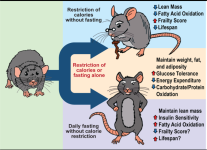
Caloric restriction for longevity.

The thermodynamics/ rate of living argument has fallen out of favor because it doesn't hold, especially for mammals and birds.
For example, birds have very high metabolisms yet some can live over 100 years. And bats are very similar to mice, yet can live over 30 years.

Furthermore, look into some of the mice studies on calorie restriction and you will find follow-up studies that divided their meals throughout the day instead of feeding them all at once. The same number of calories fed in smaller doses throughout the day, showed no longevity benefits.
This implies the benefits are coming from autophagy/phagocytosis, and another mouse experiment where they knocked out those genes showed no benefit from calorie restriction either.
 
As with many other things there are phases when it's in an adaptation process, and when it's normalized. Something may be effective when you start doing it, but then you may adapt to it and it being the new normal doesn't challenge you enough. I'm not saying this is exactly what's happening with fasting but could also be that among other things, the ghrelin levels reset and thus you feel comfortable and not hungry during the fasting window. Maybe a portion of the benefits are also lost. Maybe that's exactly what would cause the offsprings to be underweight.
Reminds me how cancer will adapt to growing on protein if you go zero carb in hopes to slow down cancer cell growth. In the study the off spring were not underweight and their parents hadn't been starved for over a decade. The children had problems controlling how fat they got. Mind you, I've met many Jewish people and few of them are overweight lol, but they are a generation or two after camps and stuff.
 
I'll stick to 4 meals minimum and 230+ grams of protein ED. This is an enhanced weightlifting forum after all. It would be fair to say we're all trying to get fucking huge.
 
I’m fasting today just for the health benefits. It’s been giving me a shitty attitude. I’ve done only protein shake fasts before. Worked well. I’ve read that when you don’t exercise and do it, won’t be wasting muscle. Sleeping becomes a problem so I popped some of my script.

Let me tell you something about muscle wasting. Didn’t exercise due to injuries for 5-6 months but kept diet to a minimum with no sugars and once a day meals at the night. Went great. Felt great. Looked great. But since I was on T3, I wasted so much muscle. The interesting part of this is that once I dropped the T3 and started eating carbs and more calories in general, without going to the gym I got my muscles back. Then started going to the gym and quickly regained where I left off. During this time I fucked up my diet and gain lots of fat too. But it’s all disciplined now and learned a big lesson. This is truly a marathon type of lifestyle. Just make sure you take the correct steps towards your goals and have patience.

I was not on anything accept T3 and gh. If you’re on test, you won’t lose so much. I’m trying to say even if you lose mass, you will easily rebound back. With or without AAS. You’ve already programmed those muscle cells. They will remember.
Yeah shitty attitude is right bro lol I like fasting I've been doing it for years and I look very young for my age but I definitely turn into a prick especially if I get bad sleeps while fasting 😅
 
The thermodynamics/ rate of living argument has fallen out of favor because it doesn't hold, especially for mammals and birds.
For example, birds have very high metabolisms yet some can live over 100 years. And bats are very similar to mice, yet can live over 30 years.

Furthermore, look into some of the mice studies on calorie restriction and you will find follow-up studies that divided their meals throughout the day instead of feeding them all at once. The same number of calories fed in smaller doses throughout the day, showed no longevity benefits.
This implies the benefits are coming from autophagy/phagocytosis, and another mouse experiment where they knocked out those genes showed no benefit from calorie restriction either.

I'm not sure what you mean by "follow-up" studies. Peer reviews? While I've read studies that attempt to debunk the conclusions and how/if it would translate into primates, I haven't seen any studies that don't show even a slight life extension from calorie restriction in mice. Do the studies you're referring to include life extension from fasting as well? Most studies I've found seem to show a slight increase in longevity from CR, but when combined with IF, the results seem to be significant. While I agree that lots of factors impede transferring the findings to humans, I understood the results on mice to be fairly conclusive. Are you able to share any of the studies you're referring to? My request is not to call you out but I'm genuinely interested.

As mentioned, there seem to be a lot of studies that show positive results. These two links are just quick searches, they appear to be drawing from different studies.


It's been a long time since I looked at them, I'll see if I can find them again. By follow-up, I mean studies controlling for more parameters, some looked at food availability and fed the calories throughout the day vs a single bolus. The single bolus, is the most common way of feeding in studies, and the mice gorge themselves so end up "fasting" until the next meal.
So yes, in a nutshell the conclusions were it was the fasting that was beneficial moreso than the calorie restriction. I should have been more clear. I'm not saying that there were no benefits of CR over ad libitum feeding, I mean to say no benefit of CR over fasting in general and inferior benefits to fasting, even when fasting had higher caloric intake. Especially so when measuring all health markers.
The data was convincing enough to me that I do four 96hr fasts per year. (Alternate day fasting in mice HED is about 72-96hrs in humans).
 
Last edited:
This was the key one that put things together for me
Using a series of feeding regimens, we dissect the effects of calories and fasting, and proceed to demonstrate that fasting alone recapitulates many of the physiological and molecular effects of CR.

Summary at end of article,
Screenshot_20240306-112544.png


These ones show supportive mechanistic evidence as to why we get benefits from the fasting vs the calorie restriction. Telomere average and maximum length increase, stem cell proliferation, and growth hormone pulse peaking post fasting cycle.


On completely another note, other studies I've read explore how CR benefits can also be explained by reduced exposure to environmental toxins, specifically ROS generation that depletes SOD and glutathione levels. Other studies delve into the importance of circadian rhythm eating being the most important factor in longevity. It's a deep hole.
 
Last edited:
This was the key one that put things together for me
Using a series of feeding regimens, we dissect the effects of calories and fasting, and proceed to demonstrate that fasting alone recapitulates many of the physiological and molecular effects of CR.

These ones show supportive mechanistic evidence as to why we get benefits from the fasting vs the calorie restriction. Telomere average and maximum length increase, stem cell proliferation, and growth hormone pulse peaking post fasting cycle.


On completely another note, other studies I've read explore how CR benefits can also be explained by reduced exposure to environmental toxins, specifically ROS generation that depletes SOD and glutathione levels. It's a deep hole.
How long and often do you fast for?
 
This was the key one that put things together for me
Using a series of feeding regimens, we dissect the effects of calories and fasting, and proceed to demonstrate that fasting alone recapitulates many of the physiological and molecular effects of CR.

Summary at end of article,
View attachment 61954


These ones show supportive mechanistic evidence as to why we get benefits from the fasting vs the calorie restriction. Telomere average and maximum length increase, stem cell proliferation, and growth hormone pulse peaking post fasting cycle.


On completely another note, other studies I've read explore how CR benefits can also be explained by reduced exposure to environmental toxins, specifically ROS generation that depletes SOD and glutathione levels. Other studies delve into the importance of circadian rhythm eating being the most important factor in longevity. It's a deep hole.


Deep hole indeed.. I tend to dive into topics and obsess over them for a bit, then move on when I feel like the information I'm getting is beginning to feel recycled. Fasting as a subject seems to have a vast amount of research and studies on animals but very conflicted opinions on whether the conclusions can be applied to humans. I'm currently time restricting my eating 5 days a week, but fudge on the weekends. There is some conflict among well-respected researchers on whether or not the full-week inconsistency is more detrimental than not fasting at all. I decided to still go ahead with it to see how I feel, but at the end of the day, it will all be anecdotal conclusions.

I will read through the studies you posted, appreciate the effort.
Agree we will never know, as we'd all be long dead even if they could start experimenting on humans today.
Animal studies have serious limitations in practical application too. For maximal mouse longevity, the alternate day feeding schedule used would equate to eating once every 72 hours for humans, for ones entire life.
And rather than expecting the big increases found in mice humans would likely scale to at best something much less than 10% increase. We are already a long lived species.
I look at the fasting research to glean similar mechanisms that have been demonstrated to show benefits in humans both acutely and over the long term.
I'm primarily interested in the HGH, stem cell increase, mitophaghy and macrophage turnover.
 
living in poverty in high crime areas correlates with living past 100. 😂

the designated ‘blue zones’ of Sardinia, Okinawa, and Ikaria corresponded to regions with low incomes, low literacy, high crime rate and short life expectancy relative to their national average. As such, relative poverty and short lifespan constitute unexpected predictors of centenarian and supercentenarian status and support a primary role of fraud and error in generating remarkable human age records
 
Top